Twenty kids can feel lively. Forty can feel like a marching band with cupcakes. If you’re wondering how to entertain large kid groups without spending the whole party saying, “Everybody sit down,” the good news is this: you do not need nonstop chaos, and you do not need a dozen complicated activities. You need a plan that keeps attention moving in the right direction.
The biggest mistake adults make with large children’s events is assuming more kids means more activities. Usually, it means the opposite. Big groups do better with fewer things, better timing, and one strong focal point that brings everyone together. When the entertainment is clear, interactive, and easy to follow, kids have more fun and grown-ups get to breathe again.
How to entertain large kid groups without losing the room
Start by thinking about energy, not just entertainment. Large groups of kids do not all arrive in the same mood. Some are ready to sprint. Some cling to a parent. Some want to be first for everything. Good party planning works because it guides that energy instead of fighting it.
A simple event flow usually works best. Give kids a chance to arrive and settle in, then move into a shared activity, then food or cake, then one final moment before pickup. That rhythm matters because children handle transitions better when the event feels predictable. If every ten minutes brings a brand-new game, the group gets scattered fast.
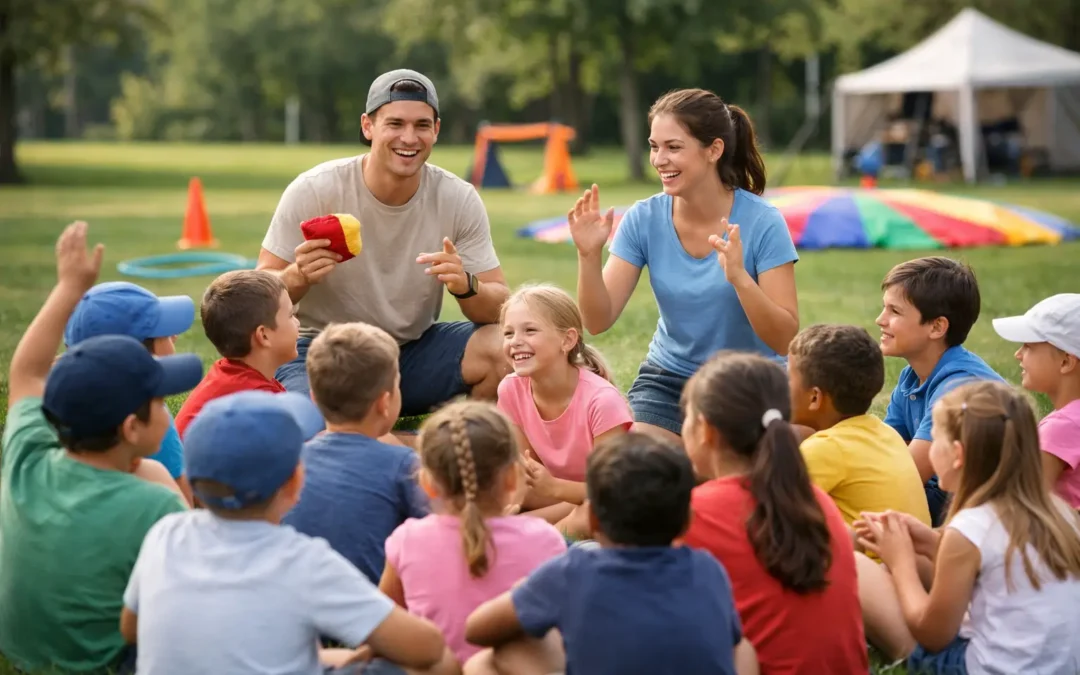
A shared performance is often the easiest anchor for a large group. There is a reason live entertainment works so well at birthday parties, school events, church gatherings, and community celebrations. It puts all eyes in one direction, creates a natural pause in the noise, and gives every child the feeling that they are part of the same experience. Interactive magic, in particular, works beautifully because the kids are not just watching. They are shouting answers, laughing together, helping from the audience, and waiting for the next surprise.
That group focus is what hosts are really looking for. Not just “something fun,” but something that keeps 25, 40, or 60 kids engaged at once.
Pick entertainment that plays big
Not every activity scales well. Crafts can be sweet for small gatherings, but with a large group they often create lines, mess, and uneven attention spans. Bounce houses burn energy, but they also split the party into kids who are bouncing, kids who are waiting, and adults who are counting heads. Relay races can be fun outside, but they depend heavily on space, weather, and a group that listens well.
The best entertainment for a big group is visible, simple to understand, and fun for different ages at the same time. That last part matters more than people expect. At many family events, you are not entertaining one age. You may have preschoolers, big kids, siblings, cousins, and a few adults trying very hard not to laugh out loud. If the activity only works for seven-year-olds, half the room checks out.
This is why interactive shows tend to outperform complicated party stations. A strong entertainer can control pacing, involve volunteers, pivot if the crowd gets wiggly, and keep both kids and adults tuned in. That is especially helpful when the host wants the event to feel exciting without feeling unruly.
If you are deciding between several options, ask one practical question: will this activity bring the group together or spread them apart? For large kid groups, together usually wins.
Why audience participation matters
Children stay engaged longer when they are invited into the action. That does not mean every child needs a turn on stage. In fact, with very large groups, that can slow things down. What works better is broad participation. Call-and-response, silly guessing, magic words, big reactions, and a few carefully chosen helpers create the feeling that everyone is involved.
That shared excitement changes the mood of the whole event. Instead of children competing for attention, they are reacting together. That is where the laughter really starts.
Set the space up for success
Room setup can make average entertainment feel great or great entertainment feel impossible. If kids are too spread out, attention drifts. If they are packed awkwardly around tables, they cannot see well and they start climbing, spinning, or poking each other. Neither is ideal.
Create one clear performance area and one clear audience area. Keep the front open and make sure children can sit where they have a good view. If adults are staying in the same room, place them behind or along the sides so they are not blocking sightlines. A semi-circle or neat rows usually works better than random clusters.
If the event is outdoors in Houston, plan for heat, sun, and sound. Kids who are too hot stop caring about your best ideas. Shade helps. Shorter transitions help. A microphone can help if the group is large enough or the setting is noisy. It is hard to entertain a big crowd when half of them cannot hear what is happening.
Also, protect the beginning. The first five minutes matter. If the kids are wandering, grabbing props, or talking over instructions, it gets harder to pull them back. A warm, confident start tells the group, “Here we go. This is the fun part.” Kids respond to that.
Keep the schedule simple
Parents often feel pressure to fill every minute. You really do not need to. In large groups, too much scheduling creates friction. Kids are moved around too often, lines get longer, and the host spends the party managing transitions instead of enjoying it.
A better approach is to choose one main entertainment piece and support it with a few easy moments around it. Arrival time can be free play. The main show can be the centerpiece. Food and cake can follow. If you want one extra activity, make it easy and short.
This is also where package-style entertainment helps. When the experience is built out clearly, the host does not have to invent the whole party from scratch. Some families want a standard show that gets everyone laughing and involved. Some want a bigger wow factor, like live animals. Some love the idea of turning the event into more than a performance by adding a beginner magic lesson and take-home trick bags. The right fit depends on the age range, the budget, and whether you want the entertainment to be a feature or the feature.
What to avoid when entertaining big groups
A few things consistently make large kid events harder than they need to be. Too many choices is one. Long waits is another. The moment kids have to stand in line for every fun thing, the mood changes.
It also helps to avoid activities with lots of tiny parts, complicated rules, or winners and losers in every round. Those setups can work in classrooms or smaller parties, but large mixed-age groups do better when the fun is immediate and nobody feels left out.
And yes, sugar plus no structure is still a real thing. Cake is wonderful. Cake before the main entertainment is often a gamble.
How to entertain large kid groups at different events
Birthday parties usually need a strong centerpiece that makes the guest of honor feel special without leaving everyone else on the sidelines. Schools and church events often need entertainment that works quickly, reads a room well, and stays family-friendly for a wide age range. Community events need something visible and flexible enough to hold attention in a busier environment.
That is why there is no one-size-fits-all answer to how to entertain large kid groups. The right choice depends on the setting. Indoors, you may be able to hold attention longer with a seated show. Outdoors, shorter segments and bigger visual moments usually help. A younger group may love sillier audience interaction. Older kids may respond better when the humor feels smart and the surprises come fast.
A seasoned performer knows how to make those adjustments in real time. That can be the difference between a party that feels choppy and one that feels easy.
For families in Houston who want something memorable without creating extra work, a live interactive magic show is one of the strongest options available. It brings the room together, keeps children engaged, gives adults something to enjoy too, and turns a busy event into a shared experience people talk about after the candles are blown out.
The best large-group entertainment does not just keep kids busy. It gives the whole party a heartbeat. When the laughter starts, the children lean in, and even the adults are smiling from the back of the room, that is when the event stops feeling like crowd management and starts feeling like a celebration.